


MIST-QG-1.0: same-language + cross-lingual stages, model card and benchmarks
Browse files- README.md +219 -0
- bench_african.png +0 -0
- bench_all.png +0 -0
- bench_crosslingual.png +0 -0
- model.safetensors +1 -1
- step.json +0 -1
README.md
ADDED
|
@@ -0,0 +1,219 @@
|
|
|
|
|
|
|
|
|
|
|
|
|
|
|
|
|
|
|
|
|
|
|
|
|
|
|
|
|
|
|
|
|
|
|
|
|
|
|
|
|
|
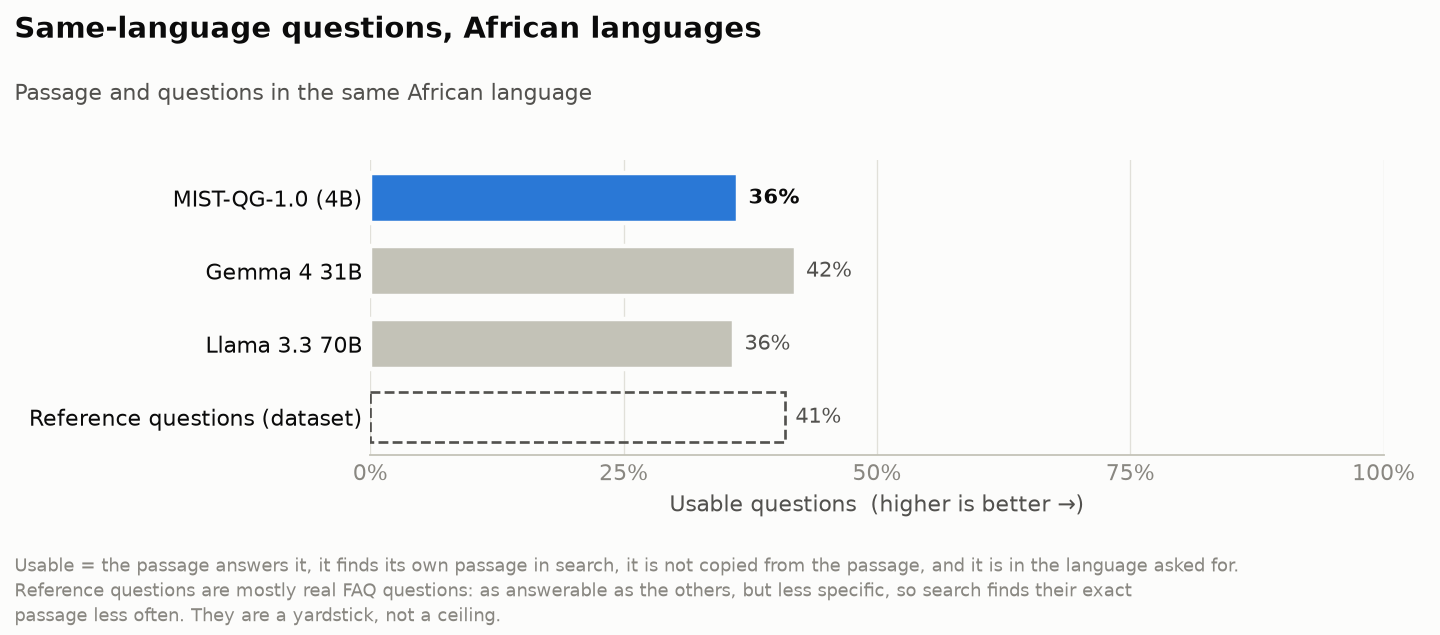
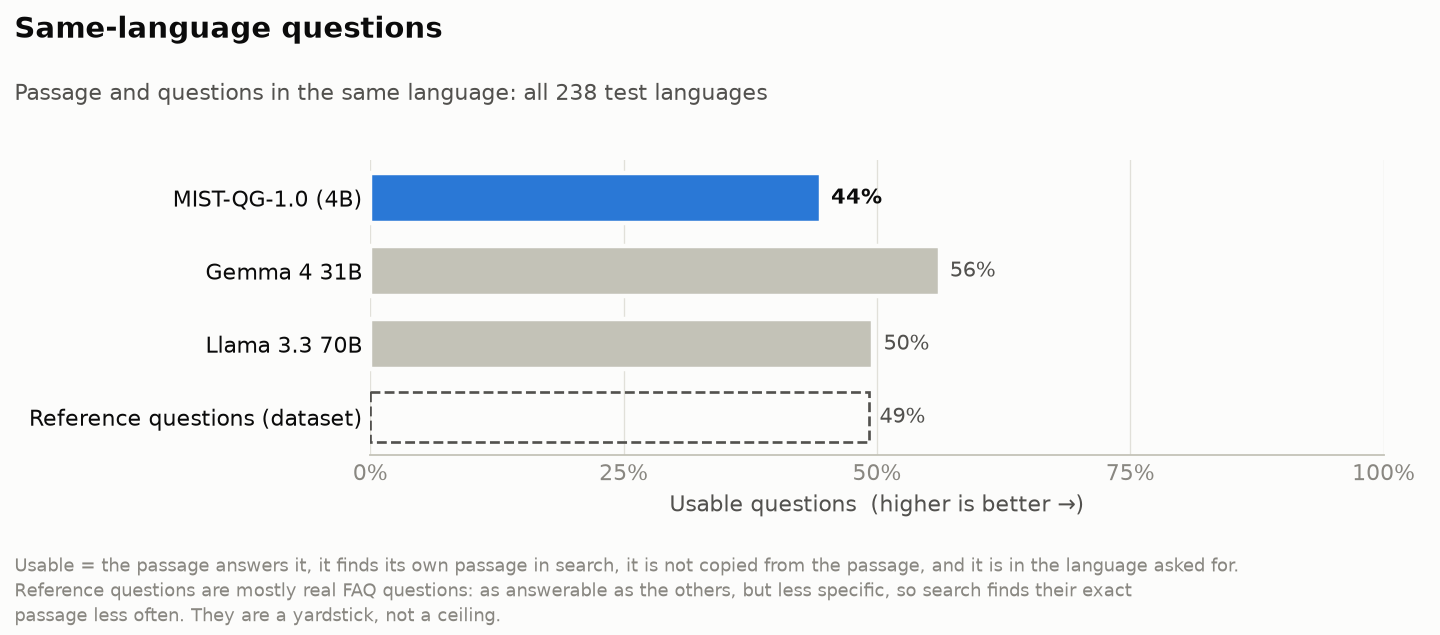
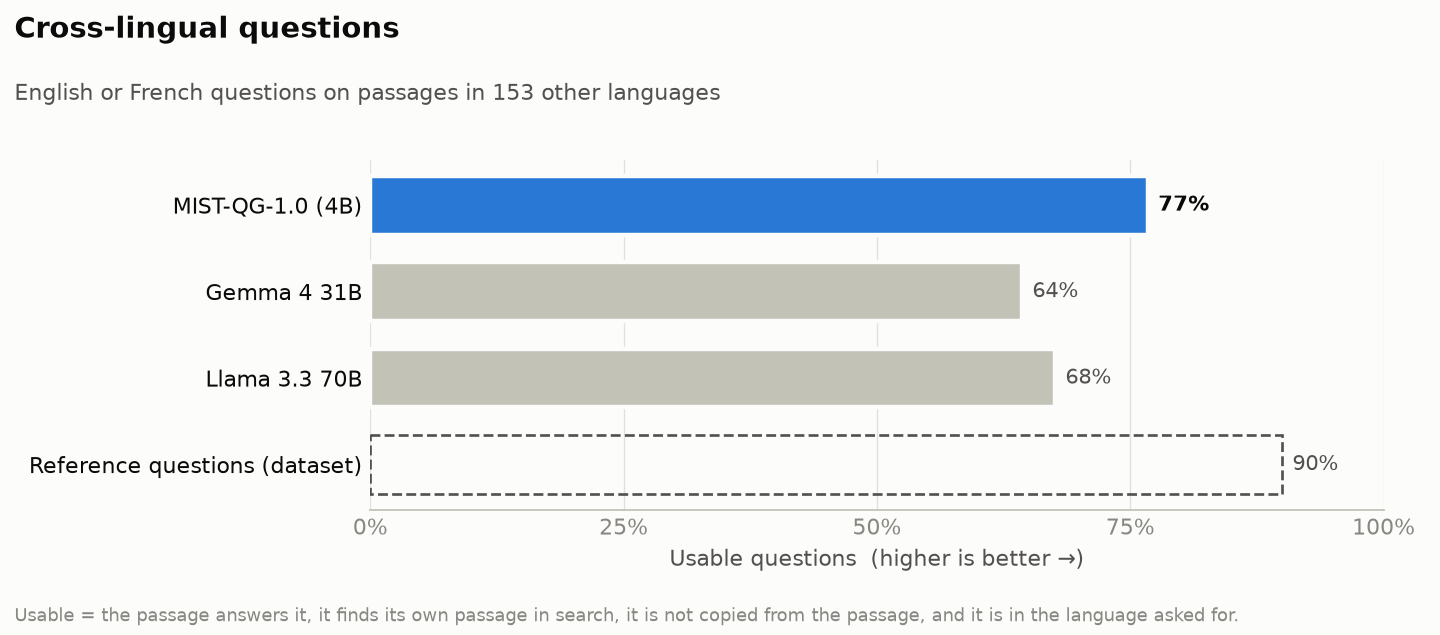
|
|
|
|
|
|
|
|
|
|
|
|
|
|
|
|
|
|
|
|
|
|
|
|
|
|
|
|
|
|
|
|
|
|
|
|
|
|
|
|
|
|
|
|
|
|
|
|
|
|
|
|
|
|
|
|
|
|
|
|
|
|
|
|
|
|
|
|
|
|
|
|
|
|
|
|
|
|
|
|
|
|
|
|
|
|
|
|
|
|
|
|
|
|
|
|
|
|
|
|
|
|
|
|
|
|
|
|
|
|
|
|
|
|
|
|
|
|
|
|
|
|
|
|
|
|
|
|
|
|
|
|
|
|
|
|
|
|
|
|
|
|
|
|
|
|
|
|
|
|
|
|
|
|
|
|
|
|
|
|
|
|
|
|
|
|
|
|
|
|
|
|
|
|
|
|
|
|
|
|
|
|
|
|
|
|
|
|
|
|
|
|
|
|
|
|
|
|
|
|
|
|
|
|
|
|
|
|
|
|
|
|
|
|
|
|
|
|
|
|
|
|
|
|
|
|
|
|
|
|
|
|
|
|
|
|
|
|
|
|
|
|
|
|
|
|
|
|
|
|
|
|
|
|
|
|
|
|
|
|
|
|
|
|
|
|
|
|
|
|
|
|
|
|
|
|
|
|
|
|
|
|
|
|
|
|
|
|
|
|
|
|
|
|
|
|
|
|
|
|
|
|
|
|
|
|
|
|
|
|
|
|
|
|
|
|
|
|
|
|
|
|
|
|
|
|
|
|
|
|
|
|
|
|
|
|
|
|
|
|
|
|
|
|
|
|
|
|
|
|
|
|
|
|
|
|
|
|
|
|
|
|
|
|
|
|
|
|
|
|
|
|
|
|
|
|
|
|
|
|
|
|
|
|
|
|
|
|
|
|
|
|
|
|
|
|
|
|
|
|
|
|
|
|
|
|
|
|
|
|
|
|
|
|
|
|
|
|
|
|
|
|
|
|
|
|
|
|
|
|
|
|
|
|
|
|
|
|
|
|
|
|
|
|
|
|
|
|
|
|
|
|
|
|
|
|
|
|
|
|
|
|
|
|
|
|
|
|
|
|
|
|
|
|
|
|
|
|
|
|
|
|
|
|
|
|
|
|
|
|
|
|
|
|
|
|
|
|
|
|
|
|
|
|
|
|
|
|
|
|
|
|
|
|
|
|
|
|
|
|
|
|
|
|
|
|
|
|
|
|
|
|
|
|
|
|
|
|
|
|
|
|
|
|
|
|
|
|
|
|
|
|
|
|
|
|
|
|
|
|
|
|
|
|
|
|
|
|
|
|
|
|
|
|
|
|
|
|
|
|
|
|
|
|
|
|
|
|
|
|
|
|
|
|
|
|
|
|
|
|
|
|
|
|
|
|
|
|
|
|
|
|
|
|
|
|
|
|
|
| 1 |
+
---
|
| 2 |
+
license: apache-2.0
|
| 3 |
+
base_model: Qwen/Qwen3.5-4B-Base
|
| 4 |
+
pipeline_tag: text-generation
|
| 5 |
+
library_name: transformers
|
| 6 |
+
tags:
|
| 7 |
+
- question-generation
|
| 8 |
+
- query-generation
|
| 9 |
+
- synthetic-data
|
| 10 |
+
- retrieval
|
| 11 |
+
- multilingual
|
| 12 |
+
- african-languages
|
| 13 |
+
- cross-lingual
|
| 14 |
+
language:
|
| 15 |
+
- multilingual
|
| 16 |
+
- en
|
| 17 |
+
- fr
|
| 18 |
+
- yo
|
| 19 |
+
- ig
|
| 20 |
+
- ha
|
| 21 |
+
- sw
|
| 22 |
+
- zu
|
| 23 |
+
- xh
|
| 24 |
+
- am
|
| 25 |
+
- so
|
| 26 |
+
- rw
|
| 27 |
+
- rn
|
| 28 |
+
- af
|
| 29 |
+
- om
|
| 30 |
+
- ti
|
| 31 |
+
- sn
|
| 32 |
+
- st
|
| 33 |
+
- tn
|
| 34 |
+
- mg
|
| 35 |
+
- ln
|
| 36 |
+
- wo
|
| 37 |
+
- ee
|
| 38 |
+
- tw
|
| 39 |
+
- ny
|
| 40 |
+
- lg
|
| 41 |
+
---
|
| 42 |
+
|
| 43 |
+
# MIST-QG-1.0
|
| 44 |
+
|
| 45 |
+
MIST-QG-1.0 reads a passage and writes the questions that the passage answers. The questions can be in the
|
| 46 |
+
passage's own language or in English or French. It is a 4B model, a full fine-tune of
|
| 47 |
+
[Qwen3.5-4B-Base](https://huggingface.co/Qwen/Qwen3.5-4B-Base), built to make retrieval training data. It covers 324
|
| 48 |
+
languages, with a focus on African languages.
|
| 49 |
+
|
| 50 |
+
It is part of the Olaverse **MIST** family, alongside MIST-Embed and MIST-Rerank. Its job is to turn raw
|
| 51 |
+
passages, in any of those languages, into query–passage pairs that an embedder or reranker can learn from.
|
| 52 |
+
|
| 53 |
+
Each chart below shows the share of a model's questions that are **usable**, so **higher is better**. A question is
|
| 54 |
+
usable when the passage answers it, it finds its own passage in search, it isn't copied from the passage, and it's
|
| 55 |
+
in the language that was asked for. The [Evaluation](#evaluation) section has the details.
|
| 56 |
+
|
| 57 |
+

|
| 58 |
+
|
| 59 |
+

|
| 60 |
+
|
| 61 |
+

|
| 62 |
+
|
| 63 |
+
## What it is good at
|
| 64 |
+
|
| 65 |
+
- **Questions in your own words, not copies.** Training targets that lifted a sentence from the passage were
|
| 66 |
+
removed. Only 7.5% of its questions copy the passage, and on African languages it copies slightly less than
|
| 67 |
+
Llama 3.3 70B (9.1% against 12.5%).
|
| 68 |
+
- **Cross-lingual questions.** Ask for English questions on a Hausa, Oromo or Malagasy passage, and 99.7% of
|
| 69 |
+
them come back in the requested language. 77% are fully usable, against 64% for Gemma 4 31B and 68% for Llama
|
| 70 |
+
3.3 70B.
|
| 71 |
+
- **Small and fast.** At 4B it runs comfortably on a single GPU with vLLM, so generating questions for millions of
|
| 72 |
+
passages is practical.
|
| 73 |
+
|
| 74 |
+
## How to use it
|
| 75 |
+
|
| 76 |
+
The prompt is plain text, with no chat template. Write the language names out in full, such as "Yoruba", "Hausa"
|
| 77 |
+
or "English".
|
| 78 |
+
|
| 79 |
+
```
|
| 80 |
+
Passage (<passage language>):
|
| 81 |
+
<passage, up to ~2,000 characters>
|
| 82 |
+
|
| 83 |
+
Questions in <question language> that this passage answers, in your own words:
|
| 84 |
+
```
|
| 85 |
+
|
| 86 |
+
The model answers with one question per line, each starting with `- `, and then stops.
|
| 87 |
+
|
| 88 |
+
### vLLM (recommended)
|
| 89 |
+
|
| 90 |
+
```python
|
| 91 |
+
from vllm import LLM, SamplingParams
|
| 92 |
+
|
| 93 |
+
PROMPT = ("Passage ({lang}):\n{passage}\n\n"
|
| 94 |
+
"Questions in {qlang} that this passage answers, in your own words:\n")
|
| 95 |
+
|
| 96 |
+
llm = LLM(model="olaverse/MIST-QG-1.0", max_model_len=4096)
|
| 97 |
+
params = SamplingParams(max_tokens=256, temperature=0.3, top_p=0.9, stop=["\n\n"])
|
| 98 |
+
|
| 99 |
+
passage = "Ọjà Ọ̀jọ̀ jẹ́ ọjà ìbílẹ̀ tó gbajúmọ̀ ní ìlú Ìbàdàn..."
|
| 100 |
+
prompts = [PROMPT.format(lang="Yoruba", qlang="Yoruba", passage=passage), # same language
|
| 101 |
+
PROMPT.format(lang="Yoruba", qlang="English", passage=passage)] # cross-lingual
|
| 102 |
+
|
| 103 |
+
for out in llm.generate(prompts, params):
|
| 104 |
+
questions = [l[2:].strip() for l in out.outputs[0].text.split("\n") if l.startswith("- ")]
|
| 105 |
+
print(questions)
|
| 106 |
+
```
|
| 107 |
+
|
| 108 |
+
### Transformers
|
| 109 |
+
|
| 110 |
+
```python
|
| 111 |
+
import torch
|
| 112 |
+
from transformers import AutoModelForImageTextToText, AutoTokenizer
|
| 113 |
+
|
| 114 |
+
tok = AutoTokenizer.from_pretrained("olaverse/MIST-QG-1.0")
|
| 115 |
+
model = AutoModelForImageTextToText.from_pretrained("olaverse/MIST-QG-1.0", dtype=torch.bfloat16).cuda()
|
| 116 |
+
|
| 117 |
+
prompt = ("Passage (Hausa):\n" + passage + "\n\n"
|
| 118 |
+
"Questions in English that this passage answers, in your own words:\n")
|
| 119 |
+
ids = tok(prompt, return_tensors="pt").input_ids.cuda()
|
| 120 |
+
out = model.generate(ids, max_new_tokens=256, do_sample=True, temperature=0.3, top_p=0.9)
|
| 121 |
+
print(tok.decode(out[0, ids.shape[1]:], skip_special_tokens=True))
|
| 122 |
+
```
|
| 123 |
+
|
| 124 |
+
Qwen3.5 is a vision-language architecture, so the model loads with `AutoModelForImageTextToText`. MIST-QG uses
|
| 125 |
+
only its text side.
|
| 126 |
+
|
| 127 |
+
## Evaluation
|
| 128 |
+
|
| 129 |
+
All systems saw the same held-out passages, which were never used in training:
|
| 130 |
+
|
| 131 |
+
- **Same language:** 2,249 test passages in 238 languages, capped at 12 passages per language. Every African-language
|
| 132 |
+
test passage was kept.
|
| 133 |
+
- **Cross-lingual:** 340 passages in 153 languages, with questions requested in English (89%) or French (11%).
|
| 134 |
+
|
| 135 |
+
Each question is checked four ways, and it counts as **usable** only if it passes all four:
|
| 136 |
+
|
| 137 |
+
1. **Answerable.** Qwen3.6-35B-A3B grades from 0 to 3 whether the passage answers the question; it must score at
|
| 138 |
+
least 2.
|
| 139 |
+
2. **Finds its passage.** Qwen3-Embedding-8B, given only the question, must rank the question's own passage first
|
| 140 |
+
among all test passages in that language. For the cross-lingual test, the pool is all 340 cross-lingual passages.
|
| 141 |
+
3. **Not copied.** Fewer than 60% of the question's word 3-grams may also appear in the passage.
|
| 142 |
+
4. **Right language.** GlotLID must identify the language that was asked for.
|
| 143 |
+
|
| 144 |
+
The other models were given a plain instruction asking for up to six questions in the target language, written in
|
| 145 |
+
their own words. The "reference questions" are the dataset's own questions for the same passages.
|
| 146 |
+
|
| 147 |
+
| Usable share | All languages | African | Cross-lingual | Cross-lingual, African passages |
|
| 148 |
+
|---|---|---|---|---|
|
| 149 |
+
| **MIST-QG-1.0 (4B)** | 0.445 | 0.363 | **0.768** | **0.682** |
|
| 150 |
+
| MIST-QG, same-language stage only | 0.447 | 0.382 | 0.005 | 0.003 |
|
| 151 |
+
| Gemma 4 31B | 0.562 | 0.420 | 0.643 | 0.565 |
|
| 152 |
+
| Llama 3.3 70B | 0.497 | 0.359 | 0.676 | 0.602 |
|
| 153 |
+
| Reference questions | 0.493 | 0.410 | 0.900 | 0.875 |
|
| 154 |
+
|
| 155 |
+
| MIST-QG-1.0, details | All languages | African | Cross-lingual |
|
| 156 |
+
|---|---|---|---|
|
| 157 |
+
| Questions per passage | 1.79 | 2.48 | 1.00 |
|
| 158 |
+
| Real questions | 99.8% | 99.8% | 100% |
|
| 159 |
+
| Copied from passage | 7.5% | 9.1% | 0.0% |
|
| 160 |
+
| In the right language | 89.6% | 94.5% | 99.7% |
|
| 161 |
+
| Answerable (judge, 0–1) | 0.856 | 0.851 | 0.821 |
|
| 162 |
+
| Finds its passage (R@1) | 0.630 | 0.504 | 0.918 |
|
| 163 |
+
|
| 164 |
+
**How to read this:**
|
| 165 |
+
|
| 166 |
+
- **Answerability matches the reference questions** (0.856 against 0.859). Most of the remaining gap is
|
| 167 |
+
round-trip retrieval: MIST-QG's questions are a little more general than the bigger models', so they find
|
| 168 |
+
their own passage less often.
|
| 169 |
+
- **Why the reference questions score below Gemma.** About 80% of them are real FAQ questions. They are as
|
| 170 |
+
answerable as Gemma's (0.857 against 0.845) but less specific, so search finds their exact passage less often
|
| 171 |
+
(0.632 against 0.697). Gemma reads the passage and fills its questions with the passage's own names and numbers.
|
| 172 |
+
The reference line is a yardstick, not a ceiling.
|
| 173 |
+
- **The cross-lingual stage cost a little on African same-language questions** (usable 0.382 → 0.363). On all
|
| 174 |
+
languages the score is unchanged.
|
| 175 |
+
- **The bigger models write six questions per passage; MIST-QG writes about two.** Every figure here is a share
|
| 176 |
+
of questions, so it measures quality, not quantity.
|
| 177 |
+
|
| 178 |
+
## Training
|
| 179 |
+
|
| 180 |
+
**Stage 1, same language.**
|
| 181 |
+
- **Data:** 991k passages in 324 languages, each paired with up to six questions in its own language. Sources:
|
| 182 |
+
WebFAQ, MQA, MIRACL, TyDi QA, parts of the KaLM fine-tuning collection, and LLM-written questions on FineWeb-2,
|
| 183 |
+
WURA and AfriCLIRMatrix passages.
|
| 184 |
+
- **Filtering:** only real questions were kept. Questions that lift a sentence from the passage were removed (tone
|
| 185 |
+
marks are ignored when matching), and duplicates were dropped.
|
| 186 |
+
- **Run:** one epoch of 7,746 steps at 128 passages per step. Learning rate 2e-5, cosine decay to 10%, 200 warm-up
|
| 187 |
+
steps.
|
| 188 |
+
|
| 189 |
+
**Stage 2, cross-lingual.**
|
| 190 |
+
- **Data:** 36.5k passages in about 300 languages, each with a question in English or French, mixed with 60k
|
| 191 |
+
same-language passages from stage 1 so the model keeps its same-language skill.
|
| 192 |
+
- **Run:** 755 steps, learning rate 1e-5, 30 warm-up steps.
|
| 193 |
+
|
| 194 |
+
**Both stages:**
|
| 195 |
+
- **Loss:** computed on the question tokens only.
|
| 196 |
+
- **Precision and optimiser:** bf16, gradient checkpointing, 8-bit AdamW (β = 0.9, 0.95).
|
| 197 |
+
- **Sequence length:** up to 1,024 tokens.
|
| 198 |
+
- **Hardware:** one A100 80 GB.
|
| 199 |
+
|
| 200 |
+
The test passages of both evaluations were held out from all training.
|
| 201 |
+
|
| 202 |
+
## Limitations
|
| 203 |
+
|
| 204 |
+
- **Copying in the rarest languages.** For a handful of very low-resource languages, such as Ga, Kimbundu,
|
| 205 |
+
Umbundu, Luba-Kasai and Aymara, the model still mostly copies the passage. Treat questions in languages with
|
| 206 |
+
little training data with care, and run a copy check on its output.
|
| 207 |
+
- **One question per passage in cross-lingual mode.** The cross-lingual training data had a single question per
|
| 208 |
+
passage, so that is what the model writes. To get more, sample several times.
|
| 209 |
+
- **Limited cross-lingual directions.** The question language is almost always English or French, and the
|
| 210 |
+
passages are mostly African languages. Other directions, such as Yorùbá questions on an English passage, were
|
| 211 |
+
not trained.
|
| 212 |
+
- **Measured by models, not people.** Answerability is judged by an LLM and retrieval by an embedder. These are
|
| 213 |
+
strong proxies, but not human ratings. Some per-language samples are small; Yorùbá has only 12 test passages.
|
| 214 |
+
- **Questions only.** It does not write answers, keyword queries or claims.
|
| 215 |
+
|
| 216 |
+
## License
|
| 217 |
+
|
| 218 |
+
The model is released under Apache-2.0, the licence of its base model, Qwen3.5-4B-Base. The training data combines
|
| 219 |
+
sources under their own licences: Apache-2.0, CC-BY-4.0, CC-BY-SA (Wikipedia text) and ODC-BY (FineWeb-2).
|
bench_african.png
ADDED
|
bench_all.png
ADDED
|
bench_crosslingual.png
ADDED
|
model.safetensors
CHANGED
|
@@ -1,3 +1,3 @@
|
|
| 1 |
version https://git-lfs.github.com/spec/v1
|
| 2 |
-
oid sha256:
|
| 3 |
size 9078620536
|
|
|
|
| 1 |
version https://git-lfs.github.com/spec/v1
|
| 2 |
+
oid sha256:f23e544bb559edef295bf7809dfd6990e9e7bef655f455aeda416596a78b5c73
|
| 3 |
size 9078620536
|
step.json
DELETED
|
@@ -1 +0,0 @@
|
|
| 1 |
-
{"step": 7745, "time": 1794535272.2371998}
|
|
|
|
|
|