---
language:
- en
library_name: transformers
pipeline_tag: text-generation
base_model: ibm-granite/granite-4.2-3b
license: other
license_name: webai-non-commercial-license-ver.-1.0
license_link: https://huggingface.co/webAI-Official/Meridian-smaller/blob/main/LICENSE.md
tags:
- granite
- granite-4.2
- formal-logic
- reasoning
- lora
- model-merging
- wise-ft
- reinforcement-learning
- grpo
- gguf
- meridian
---
# Meridian-smaller
A 3.66B reasoning model for **formal logic** tasks, built from
[`ibm-granite/granite-4.2-3b`](https://huggingface.co/ibm-granite/granite-4.2-3b) through LoRA
supervised fine-tuning, checkpoint fusion, WiSE-FT weight interpolation, and entropy-weighted
GRPO reinforcement learning.
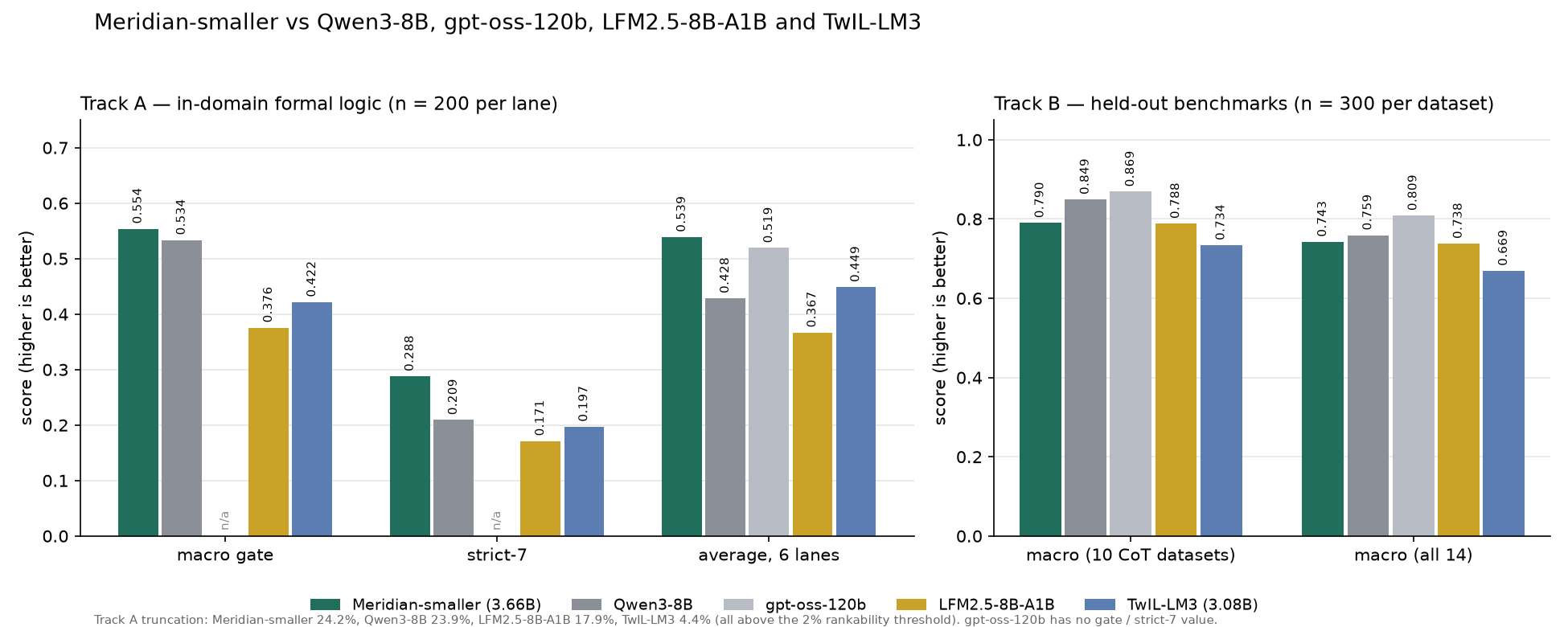
It improves in-domain formal-logic performance by **+28% relative** over its base model
(macro gate 0.431 → 0.554) **while holding held-out benchmark performance** — the 10-dataset
macro is level with the base (0.7942 → 0.7901) and the 14-dataset macro improves slightly
(0.7332 → 0.7425). On the same harness and sampled rows it reaches the highest Track A macro
gate, strict-7 and six-lane average of any arm in the tables below for which each can be
computed, including Qwen3-8B and gpt-oss-120b (the 120B has no gate or strict-7 value).
## Highlights
* **Large in-domain gain on the same harness.** Macro gate 0.4313 → 0.5539 (+0.123) and strict-7
0.1821 → 0.2879 against its own base, measured on identical sampled rows. Both models are
heavily truncated at this budget (see [Limitations](#limitations-and-caveats)), and the base
more so, so the size of the gap is indicative rather than exact.
* **Top of the Track A summary rows at 3.66B.** Macro gate 0.5539 against Qwen3-8B's 0.5336
(2.2x the parameters) and TwIL-LM3's 0.4218; strict-7 0.2879 against 0.2093 and 0.1971;
six-lane average 0.5389 against gpt-oss-120b's 0.5192. The gate lead over Qwen3-8B is 0.020 —
smaller than the sampling noise at n = 200 per lane — so read that one as parity, not a win.
* **Strongest strict MCQ and language-model fit in the table.** `mcq_answer` strict accuracy
0.4100 (next best 0.1200), `lean_critic` 0.7950 (tied with Qwen3-8B and its own base), and the
lowest `lm_corpus` and `math_corpus` perplexity of any comparable arm (2.3130 and 3.6983).
* **Holds general capability.** Track B 10-dataset macro 0.7901 and 14-dataset macro 0.7425 —
ahead of LFM2.5-8B-A1B (0.7884 / 0.7378) at less than half its parameter count, and behind
Qwen3-8B (0.8493 / 0.7591) and gpt-oss-120b (0.8689 / 0.8086). It gains on BBH-logic
(0.9013 → 0.9540), MATH-500 (0.6567 → 0.7467) and MuSR (0.5922 → 0.6409), and gives back
GSM-Symbolic (0.8900 → 0.8267) and ARC (0.8933 → 0.8600).
* **Structured formal output.** Tuned for the objects rather than the prose: FOL translation,
entailment labels, semantic parses, Lean statements and Lean proof critique.
* **Runs anywhere.** 3.66B parameters in bf16 (6.82 GiB), with a Q4\_K\_M GGUF at 2.09 GiB for
CPU or 4 GB of VRAM.
It is **not efficient**: it reasons at length. Track A generations average 1,902 tokens, against
564 for TwIL-LM3, and 24.2% of them hit the length cap. It is also not a general assistant —
there is no safety or preference tuning here beyond what Granite 4.2 carries. See
[Limitations](#limitations-and-caveats).
## Model Details
| Property | Value |
| ------------------------- | ---------------------------------------------------------------------------------------------- |
| Model ID | `webAI-Official/Meridian-smaller` |
| Base model | [`ibm-granite/granite-4.2-3b`](https://huggingface.co/ibm-granite/granite-4.2-3b) |
| Total parameters | 3.66B (3,659,737,600) |
| Architecture | Granite decoder-only dense transformer (`GraniteForCausalLM`); 40 layers, hidden size 2560, 40 attention heads / 8 KV heads |
| Input / output | Text / text |
| Language | English |
| Tokenizer vocabulary size | 100,352 |
| Context window | 131,072 tokens |
| Checkpoint precision | bfloat16 (6.82 GiB), plus Q4\_K\_M / Q5\_K\_M / Q6\_K / Q8\_0 / F16 GGUF builds |
| Post-training | LoRA SFT → checkpoint fusion → WiSE-FT (α = 0.15) → MGPO reinforcement learning (β = 0.02, step 2580) |
| Reasoning format | Emits a `…` block before the answer (default chat template) |
| Evaluated decoding | Greedy, 2048 new tokens (one retry at 4096), `max_seq_len` 8192 |
| Specialisation | Formal logic: FOL translation, entailment, semantic parsing, Lean formalisation and critique |
| License | webAI Non-Commercial License ver. 1.0 |
The base model's 131,072-token context is carried through unchanged, but every score on this card
was measured inside an 8,192-token window; longer contexts are inherited rather than validated
here.
## Results
### Track A — in-domain formal logic
Meridian-smaller and its base were run through the same harness, prompts, decoding settings and
sampled rows described under [Evaluation protocol](#evaluation-protocol), and the peer columns
are the values already published for TwIL-LM3 on its card, produced by that same harness (see
[Comparability](#limitations-and-caveats)). Throughput rows are reported where a dedicated
throughput measurement exists: `ans/s` is defined throughout as `tok/s ÷ mean generation length`,
so it measures completed answers rather than raw decode rate.
| lane / metric | Meridian-smaller | Granite-4.2-3B base | TwIL-LM3 | Llama-3.2-3B | LFM2-2.6B | LFM2.5-8B-A1B | Qwen3-8B | gpt-oss-120b ‡ |
|---|---:|---:|---:|---:|---:|---:|---:|---:|
| lean_formalize token_f1 | 0.5092 | 0.2943 | 0.5869 | 0.3690 | 0.1321 | 0.4655 | 0.4022 | **0.6306** |
| rule_induction derivation | 0.4195 | 0.2267 | 0.3192 | 0.0825 | 0.0615 | 0.1936 | 0.3680 | **0.6518** |
| entailment_label accuracy | 0.6700 | 0.3000 | 0.5750 | 0.3300 | 0.4700 | 0.5400 | 0.5800 | **0.7750** |
| mcq_answer accuracy | **0.4100** | 0.1200 | 0.1100 | 0.0000 | 0.0150 | 0.0750 | 0.0000 | 0.0700 |
| semantic_parse token_f1 | 0.4295 | 0.3910 | **0.4416** | 0.3102 | 0.3665 | 0.3778 | 0.4257 | 0.4331 |
| lean_critic accuracy | **0.7950** | **0.7950** | 0.6600 | 0.5300 | 0.5900 | 0.5500 | **0.7950** | 0.5550 |
| lm_corpus perplexity ↓ | **2.3130** | 2.6334 | 2.8972 | 2.8478 | 4.3815 | 4.9472 | 2.5440 | 912.23 § |
| math_corpus perplexity ↓ | **3.6983** | 4.4864 | 3.8229 | 4.7531 | 6.7472 | 8.3323 | 4.0083 | 1045.63 § |
| average, 6 lanes | **0.5389** | 0.3545 | 0.4488 | 0.2703 | 0.2725 | 0.3670 | 0.4285 | 0.5192 |
| **macro gate** | **0.5539** | 0.4313 | 0.4218 | 0.2925 | 0.3473 | 0.3757 | 0.5336 | — |
| **strict-7** | **0.2879** | 0.1821 | 0.1971 | 0.1229 | 0.1579 | 0.1714 | 0.2093 | — |
| macro_primary | **0.5875** | 0.4825 | 0.4475 | 0.3450 | 0.4188 | 0.4213 | 0.5750 | — |
| tok/s | — | — | 15880 | 16160 | **25230** | 22480 | 9420 | 3374 |
| mean gen length | 1902 | 2951 | **564** | 696 | 2296 | 1830 | 2094 | 1005 |
| **ans/s** | — | — | **28.1** | 23.2 | 10.9 | 12.0 | 4.5 | 3.4 |
‡ **gpt-oss-120b** runs MXFP4 weights at tensor-parallel 2 — quantized and multi-GPU, so its
throughput rows are not directly comparable to the single-GPU BF16 arms. Its `procedural` lane
and the loose-match scorings were not collected, so the three summary rows below the six-lane
average cannot be computed for it; that is what the — cells mean, not a zero.
§ The 120B's perplexities are three orders of magnitude off every other arm because its response
format and tokenizer make the corpus lanes score a different quantity. The number is reported
for completeness but is not a comparable measurement, and is excluded from the bolding.
**Throughput cells marked — for Meridian-smaller and its base.** The peer throughput columns come
from a separate dedicated throughput measurement that was not run for these two models, so
`tok/s` and `ans/s` are left blank rather than mixed with the in-run decode rate (which is on a
different basis). `mean gen length` is measured directly under the shared protocol and is
comparable across every column.
**`average, 6 lanes`** is the plain mean of the six objective rows above it, each at whatever
scoring that row reports (Lean F1, rule derivation, entailment, MCQ strict, semantic F1, critic).
It is a coarser summary than the three that follow — it mixes token-F1 with accuracy — but it is
the only summary row every arm here can be compared on, including the 120B.
The next three rows aggregate more carefully. None of them include the perplexity lanes or the
token-F1 scorings, which are not on a common 0–1 accuracy scale.
**`macro gate`** is the headline metric and the one the training pipeline gates on. It is the
equal-weight mean of five objectives: the four bounded classification lanes (`entailment_label`,
`mcq_answer`, `procedural`, `lean_critic`) plus `rule_induction`, scored by its continuous
derivation score. In the gate, `mcq_answer` and `procedural` are credited as
`max(exact_match, loose_match)`: for free-text answer lanes, a response that is correct but
differently formatted is a formatting artefact rather than a reasoning failure. This affects the
aggregate only — the per-lane rows above stay strict. (Meridian-smaller's loose-match MCQ is
0.6500 against the 0.4100 strict figure shown in the lane row.)
**`macro_primary`** is the same mean over the four classification lanes alone, without
`rule_induction`.
**`strict-7`** is the mean of seven lanes scored under strict metrics only (`fol_translation`,
`entailment_label`, `mcq_answer`, `semantic_parse` and `lean_formalize` exact match,
`lean_critic` and `procedural` accuracy), with no loose-match credit anywhere. It is deliberately
harsh — exact match on generative lanes is near zero for every arm — so it is useful for ranking
models against each other but not as an absolute capability measure.
Meridian-smaller leads all four summary rows that every arm with a computable value can be
compared on. The clearest margins are over the arms at its own scale and above: 0.5539 against
0.3757 on the gate for LFM2.5-8B-A1B, and 0.2879 against 0.1971 on strict-7 for TwIL-LM3. Against
Qwen3-8B the gate gap is only 0.020, but strict-7 is 0.2879 against 0.2093 — a difference that
does not depend on loose-match credit — and Meridian-smaller leads on MCQ (strict 0.4100 against
0.0000), rule induction (0.4195 against 0.3680) and both perplexity lanes.
It does not lead every lane. gpt-oss-120b is clearly stronger on `rule_induction` (0.6518),
entailment (0.7750) and Lean formalisation (0.6306), and TwIL-LM3 remains ahead on Lean
formalisation (0.5869 against 0.5092) and semantic parsing (0.4416 against 0.4295). The two weak
spots in absolute terms are `procedural` (strict 0.1200, loose 0.2350) and FOL translation
(exact match 0.0100).
### Track B — held-out benchmarks
| dataset | Meridian-smaller | Granite-4.2-3B base | TwIL-LM3 | Llama-3.2-3B | LFM2-2.6B | LFM2.5-8B-A1B | Qwen3-8B | gpt-oss-120b ‡ |
|---|---:|---:|---:|---:|---:|---:|---:|---:|
| gsm8k | 0.9433 | 0.9533 | 0.8733 | 0.8300 | 0.8767 | 0.9133 | 0.9567 | **0.9767** |
| svamp | **0.9500** | 0.9200 | 0.8500 | 0.8200 | 0.9000 | 0.9133 | 0.9400 | 0.9400 |
| gsm_symbolic | 0.8267 | 0.8900 | 0.7567 | 0.8067 | **0.9767** | 0.9267 | 0.8133 | 0.8467 |
| arc_cot | 0.8600 | 0.8933 | 0.8467 | 0.7967 | 0.8667 | 0.9033 | 0.9633 | **0.9667** |
| logicbench | 0.7933 | 0.7733 | 0.7167 | 0.5733 | 0.6267 | 0.7200 | **0.8567** | 0.8533 |
| strategyqa | 0.5967 | 0.6267 | 0.6500 | 0.6533 | 0.6433 | 0.6667 | 0.7400 | **0.7867** |
| drop | 0.7367 | 0.7467 | 0.7467 | 0.6733 | 0.6900 | 0.6633 | **0.8833** | 0.8500 |
| csqa | 0.7667 | 0.7733 | 0.7367 | 0.7500 | 0.7433 | 0.7700 | **0.8633** | 0.8367 |
| musr | 0.6409 | 0.5922 | 0.4957 | 0.4932 | 0.4867 | 0.5703 | 0.6301 | **0.6852** |
| mmlu_redux | 0.7867 | 0.7733 | 0.6667 | 0.6000 | 0.7133 | 0.8367 | 0.8500 | **0.9467** |
| ifeval | 0.7500 | 0.7633 | 0.6433 | 0.7167 | 0.7300 | **0.8900** | 0.8400 | 0.7900 |
| rudas_ood | 0.0437 ¶¶ | 0.0012 | 0.0365 | **0.0733** | 0.0017 | 0.0061 | 0.0468 | 0.0000 ¶ |
| bbh_logic | 0.9540 | 0.9013 | 0.6633 | 0.5333 | 0.5713 | 0.7700 | 0.6367 | **0.9980** |
| math500 | 0.7467 | 0.6567 | 0.6900 | 0.4233 | 0.7133 | 0.7800 | 0.6100 | **0.8433** |
| **macro (10 CoT datasets)** | 0.7901 | 0.7942 | 0.7339 | 0.6997 | 0.7523 | 0.7884 | 0.8493 | **0.8689** |
| **macro (all 14)** | 0.7425 | 0.7332 | 0.6694 | 0.6245 | 0.6814 | 0.7378 | 0.7591 | **0.8086** |
| tok/s | — | — | 15880 | 16160 | **25230** | 22480 | 9420 | 3374 |
| mean gen length | ≈792 | ≈1282 | **482** | 510 | ≈796 | ≈1327 | ≈1931 | 801 |
| **ans/s** | — | — | **32.9** | 31.7 | ≈31.7 | ≈16.9 | 4.9 | 4.2 |
‡ MXFP4 weights, tensor-parallel 2 — quantized and multi-GPU, so not directly comparable to the
single-GPU BF16 rows. ¶ 74% of its `rudas_ood` generations hit the length cap, so that cell is a
truncation artefact rather than a measured score; excluding the row, its 13-dataset macro is
0.8708. ¶¶ 93.7% of Meridian-smaller's `rudas_ood` generations also hit the length cap, so its
cell is likewise a truncation artefact rather than a measurement of the model's ability.
Lengths marked ≈ are derived from stored generations rather than read from the run. For
Meridian-smaller and its base they were re-tokenized directly with the model's own tokenizer and
averaged over the 14 datasets (MuSR counted once); the same method reproduces TwIL-LM3's measured
482 to within 1%. The peer lengths marked ≈ use each model's characters-per-token ratio and are
carried over from the TwIL-LM3 card. `tok/s` and `ans/s` are blank for Meridian-smaller and its
base for the reason given under the Track A table.
The honest summary of this table is that Meridian-smaller does not lead it. Larger models score
higher, and gpt-oss-120b leads seven of the fourteen dataset rows. Three things are worth
extracting anyway. First, it holds its own base on the held-out suite (10-dataset macro 0.7901
against 0.7942, a difference well inside the sampling noise at n = 300 per dataset) while gaining
in-domain, which is the point of the WiSE-FT stage. Second, the 14-dataset macro rises 0.0093
over the base, driven by BBH-logic, MATH-500 and MuSR. Third, it edges LFM2.5-8B-A1B on both
macros at less than half the parameters and leads the table outright on SVAMP (0.9500).
Track B here was run with the chat template's thinking mode **disabled** for Meridian-smaller and
its base (the prompt ends in an empty ``), as it was for TwIL-LM3, whereas Track A
uses the default thinking mode. The Track B numbers therefore describe non-reasoning behaviour;
they are not a measure of what a thinking-mode generation would score. Some Track B cells are also
truncation-limited: MATH-500 hits the cap on 14.0% of rows, and SVAMP, GSM-Symbolic and
MuSR-team sit slightly above the 2% cap-hit threshold (3.0%, 3.0% and 2.8%).
### Checkpoint selection
MGPO checkpoints were compared on both tracks, and step 2580 was published because it has the
best (or tied-best) held-out score rather than the best in-domain gate:
| checkpoint | macro gate | macro_primary | B10 | B14 | Track A truncation |
|---|---:|---:|---:|---:|---:|
| WiSE-FT α = 0.15 (RL initialiser) | 0.531 | 0.583 | — | — | 27.6% |
| MGPO step 1200 | **0.569** | **0.598** | 0.7819 | 0.7362 | 21.0% |
| MGPO step 2000 | 0.557 | 0.581 | 0.7882 | 0.7425 | 23.1% |
| MGPO step 2200 | 0.567 | 0.583 | 0.7865 | 0.7406 | 23.3% |
| **MGPO step 2580 (published)** | 0.554 | 0.588 | **0.7901** | **0.7425** | 24.2% |
Track A gate here uses the same definition as the tables above (rule induction included).
Step 1200 leads the gate by 0.015 and `macro_primary` by 0.010, but step 2580 has the highest
10-dataset macro and ties step 2000 on the 14-dataset macro (0.7425 for both at four decimals),
and the differences between the later checkpoints on Track A are within sampling noise at
n = 200. The checkpoint-selection probe recorded for this release (100 prompts each from FOL
translation, entailment and math MCQ, eight sampled completions per prompt at
`temperature = 0.8`, `top_p = 0.95`) gave macro Pass@1 0.4071 and macro Pass@8 0.5567. That probe
is a selection tool, not a benchmark claim.
## Usage
```python
import torch
from transformers import AutoModelForCausalLM, AutoTokenizer
model_id = "webAI-Official/Meridian-smaller"
tok = AutoTokenizer.from_pretrained(model_id)
model = AutoModelForCausalLM.from_pretrained(
model_id, torch_dtype=torch.bfloat16, device_map="auto"
)
messages = [{"role": "user", "content":
"Does 'All dogs are mammals. Rex is a dog.' entail 'Rex is a mammal'? "
"Answer entailment, contradiction, or neutral."}]
inputs = tok.apply_chat_template(
messages, add_generation_prompt=True,
return_tensors="pt", return_dict=True,
).to(model.device)
out = model.generate(**inputs, max_new_tokens=2048, do_sample=False)
print(tok.decode(out[0][inputs["input_ids"].shape[-1]:], skip_special_tokens=True))
```
`return_dict=True` matters on transformers 5.x, where `apply_chat_template` returns a
`BatchEncoding` rather than a bare tensor; the above works on both 4.x and 5.x. Use a
Transformers release with Granite 4.2 support.
The reported numbers use **greedy decoding** (`do_sample=False`) and a **2048-token** generation
budget. Note that the shipped `generation_config.json` enables sampling (`do_sample=true`,
`temperature=1.0`, `top_p=0.95`), so `do_sample=False` must be passed explicitly to reproduce the
evaluation. By default the chat template opens a `` block, so the model reasons before it
answers and a short generation budget truncates that reasoning and scores far worse. The template
also accepts `enable_thinking=False` (empty think block, lower latency and lower quality on
reasoning-heavy tasks) and `reasoning_effort="low"` through `chat_template_kwargs`.
### GGUF / llama.cpp
Quantized GGUF builds ship in this repository alongside the safetensors weights. The Granite
architecture is supported by llama.cpp; the model uses a ChatML-style template with `<|im_end|>`
as EOS, so run it in conversation mode (`-cnv`).
| file | quant | size | bits/weight | notes |
|---|---|---:|---:|---|
| `Meridian-smaller-Q4_K_M.gguf` | Q4_K_M | 2.09 GiB | 4.91 | recommended default; runs on CPU or 4 GB of VRAM |
| `Meridian-smaller-Q5_K_M.gguf` | Q5_K_M | 2.43 GiB | 5.71 | a little more headroom than Q4_K_M |
| `Meridian-smaller-Q6_K.gguf` | Q6_K | 2.80 GiB | 6.57 | close to Q8_0 quality at about three-quarters the size |
| `Meridian-smaller-Q8_0.gguf` | Q8_0 | 3.63 GiB | 8.51 | near-lossless, for quality-sensitive use |
| `Meridian-smaller-F16.gguf` | F16 | 6.82 GiB | 16.01 | unquantized, for requantization or reference runs |
```bash
llama-cli -hf webAI-Official/Meridian-smaller:Q4_K_M -cnv --temp 0 -n 2048
```
Two things matter for reproducing the scores above under llama.cpp. Pass `--temp 0`, because the
evaluation is greedy while the packaged sampling defaults are not. And leave the generation
budget large — 2048 tokens or more — since the model emits a `` block before answering
and a short budget truncates it, which costs far more accuracy than the quantization does.
F16 and Q8_0 were produced directly by `convert_hf_to_gguf.py` from the released bf16 weights; the
K-quants (Q4_K_M, Q5_K_M, Q6_K) were quantized from the F16 build with `llama-quantize`, without
an importance matrix. F16 is not bit-identical to the released weights: bf16 and f16 carry the
same 16 bits but trade exponent range against mantissa precision, so the conversion is a
narrowing one, in practice negligible for inference.
The published Track A and Track B numbers were measured on the **bf16** weights through vLLM, not
on any of these GGUF builds, so expect small deviations — most likely at Q4_K_M — that have not
been quantified here.
## How it was built
Four stages on top of the base model:
1. **LoRA supervised fine-tuning** on a synthetic formal-logic corpus covering the Track A
objectives (first-order-logic translation, entailment labelling, semantic parsing, Lean
formalisation and critique, procedural reasoning, rule induction).
2. **Checkpoint fusion** — parameter-space averaging of intermediate SFT checkpoints, rather
than taking the final checkpoint.
3. **WiSE-FT interpolation** toward the pretrained base, `W = (1 − α)·W_base + α·W_finetuned`
with **α = 0.15** — i.e. only 15% of the fine-tuned delta is retained. This conservative
interpolation is the direct reason held-out capability survives.
4. **MGPO** — entropy-weighted GRPO reinforcement learning against a programmatic verifier, with
partial credit for loose matches and token-F1 so that all-fail prompt groups still produce
gradient. Group size 16, learning rate 5e-6, sampling temperature 1.0, top-p 0.95,
γ = 3.0. The run was resumed at step 800 with β = 0.02 and trained through step 2580, and the
published checkpoint is **step 2580**. This release is the merged policy, not a LoRA adapter.
## Limitations and caveats
**Truncation.** At a 2048-token budget (one retry at 4096), **24.2%** of Track A generations
hit the cap. That is far above the 2% threshold our protocol requires to mark a comparison
`rankable`, so the Track A numbers are **not rankable** and should be read as indicative rather
than exact. The base is worse (49.2%), and both are pessimistic because a truncated response
scores zero regardless of reasoning quality — so the true Track A gap over the base is probably
narrower than +0.123, and part of the improvement is shorter generations rather than better
answers. For context, Qwen3-8B truncates 23.9% of rows, LFM2.5-8B-A1B 17.9%, LFM2-2.6B 41.3% and
Llama-3.2-3B 10.0% under the same budget, TwIL-LM3 4.4%. Some Track B stages are also flagged
unrankable for the same reason (`rudas_ood` 93.7% cap-hit, `math500` 14.0%, plus marginal excess
on SVAMP, GSM-Symbolic and MuSR-team); the held-out core, retention, IFEval and log-likelihood
stages are rankable.
**Verbose by construction.** Track A generations average 1,902 tokens and Track B generations
about 792, so cost per answer is substantially higher than the TwIL-LM family (564 and 482 tokens)
even though quality per answer is higher on Track A.
**Scope.** Tuned for formal logic. The Track B suite does not cover code generation or tool use
(HumanEval, LiveCodeBench and BFCL were not run for this model or its base), so this release
makes no claim about those. The weak absolute areas inside the specialisation are FOL translation
(exact match 0.0100), `procedural` (strict 0.1200) and semantic parsing exact match (0.0000);
`rule_induction` parses only 56.5% of outputs.
**Not a chat model.** It was optimised against automatic verifiers on logic tasks. It has had no
safety tuning beyond whatever the base model carries, and no instruction-following alignment
work — IFEval is 0.7500 against the base's 0.7633.
**Comparability.** For Track A, Meridian-smaller, its base, Qwen3-8B, LFM2-2.6B, LFM2.5-8B-A1B
and Llama-3.2-3B were checked to share the same sampled-row manifest and dataset hash, seed and
decoding; the TwIL-LM3 and gpt-oss-120b values are carried over from the TwIL-LM3 card, which
describes the same harness. For Track B, the arms checked share the same sampled rows and
decoding, but the serving engine differs between arms (vLLM 0.19.1 for Meridian-smaller, its base,
Qwen3-8B and LFM2.5-8B-A1B; vLLM 0.11.2 for TwIL-LM3 and Llama-3.2-3B), and the engine version is
part of the protocol hash. With n = 200 per lane on Track A and n = 300 per dataset on Track B,
differences of two to three points are within sampling noise.
## Evaluation protocol
- Track A: `n = 200` per objective, greedy (`temperature = 0`), `max_new_tokens = 2048`, one
retry at 4096 for truncated rows, `max_seq_len = 8192`, seed 42, default (thinking-enabled)
chat template.
- Track B: 300 examples per task, greedy, `max_gen_toks = 4096`, `max_model_len = 8192`,
`repetition_penalty = 1.0`, chat template applied with thinking disabled, vLLM backend.
- Both tracks use the same protocol for the model and its base, in a paired run over identical
sampled rows.
`repetition_penalty = 1.0` is load-bearing. A 1.1 penalty produced apparent 20-point swings on
Track B that were pure decoding artefact; the decoding kwargs are hashed into the protocol
identity so a mismatched runner fails loudly instead of quietly producing a different number.
## Relationship to TwIL-LM
Meridian-smaller applies the same post-training pipeline as the
[TwIL-LM3](https://huggingface.co/webAI-Official/TwIL-LM3) and TwIL-LM family — LoRA SFT,
checkpoint fusion, WiSE-FT and MGPO — to a different base, IBM's Granite 4.2 3B, instead of
SmolLM3 or SmolLM2. Compared with TwIL-LM3 it is a stronger in-domain model (macro gate 0.5539
against 0.4218) and a stronger held-out one (10-dataset macro 0.7901 against 0.7339), at the
price of much longer generations and a much higher truncation rate. Like the TwIL-LM models, it
ships as a full merged model on `main`, loaded directly with `AutoModelForCausalLM`.
## License and attribution
Released under the **webAI Non-Commercial License ver. 1.0** — see `LICENSE.md` in this
repository.
The base model, [`ibm-granite/granite-4.2-3b`](https://huggingface.co/ibm-granite/granite-4.2-3b),
is Copyright IBM Corporation and is distributed under the Apache License 2.0; its licence text is
retained as `apache-2.0-LICENSE.txt` and all credit for the base model goes to IBM. Apache 2.0
permits distributing derivative works under different terms provided attribution is preserved,
which is what the pair of licence files in this repository does.