

license: apache-2.0
RVR: One-step Generative Streaming Real-time Video Restoration
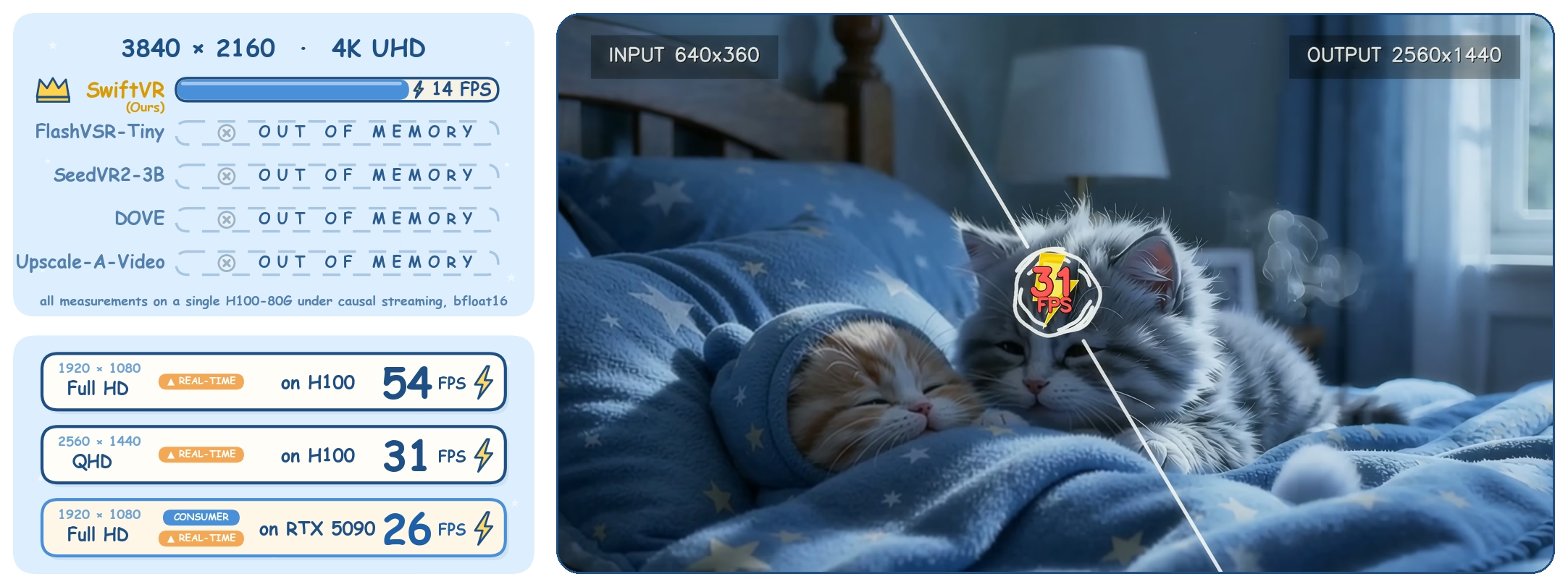
RVR is the first generative video restoration model to reach real-time 1080p streaming on a consumer-grade GPU (≈26 FPS on a single RTX 5090), sustains 31 FPS at QHD (2560×1440) and 14 FPS at 4K (3840×2160) on a single H100, and streams at resolutions where every compared diffusion-based VR baseline runs out of memory.




Updates
- [2026/06] Release the inference code and pretrained weights 🎉
✨ Highlights
- Mask-free shifted-window self-attention (MFSWA). Each spatial window is pre-gathered into a dense tensor, so every attention call reduces to a single standard scaled-dot-product (SDPA) call — no attention mask, cyclic shift, or padding ever enters the graph. This gives a 1.62× throughput gain over its full-attention teacher at essentially identical quality, with no dedicated sparse kernel.
- Restoration-aware Autoencoder (ReAE). A lightweight encoder–decoder jointly fine-tuned with the DiT in pixel space removes the heavy-3D-VAE / tiled-decoding bottleneck.
- Causal chunk-wise streaming. A minimal causal protocol (no rolling KV cache, no overlapped DiT inference) bounds the temporal axis, confining the residual (\mathcal{O}(N^2)) cost to the spatial axes.
📊 Results
Efficiency at 2560×1440 (single H100, causal streaming, 24 frames)
| Metric | SeedVR2-3B (tile) | DOVE (tile) | FlashVSR-Tiny | RVR (Ours) |
|---|---|---|---|---|
| Avg. Time (s) ↓ | 17.320 | 27.615 | 2.493 | 0.766 |
| FPS ↑ | 1.39 | 0.85 | 9.61 | 31.32 |
| Peak Mem. (GB) ↓ | 35.35 | 59.24 | 34.35 | 38.01 |
At 3840×2160, every compared diffusion-based VR baseline OOMs on a single H100; RVR sustains 14 FPS.
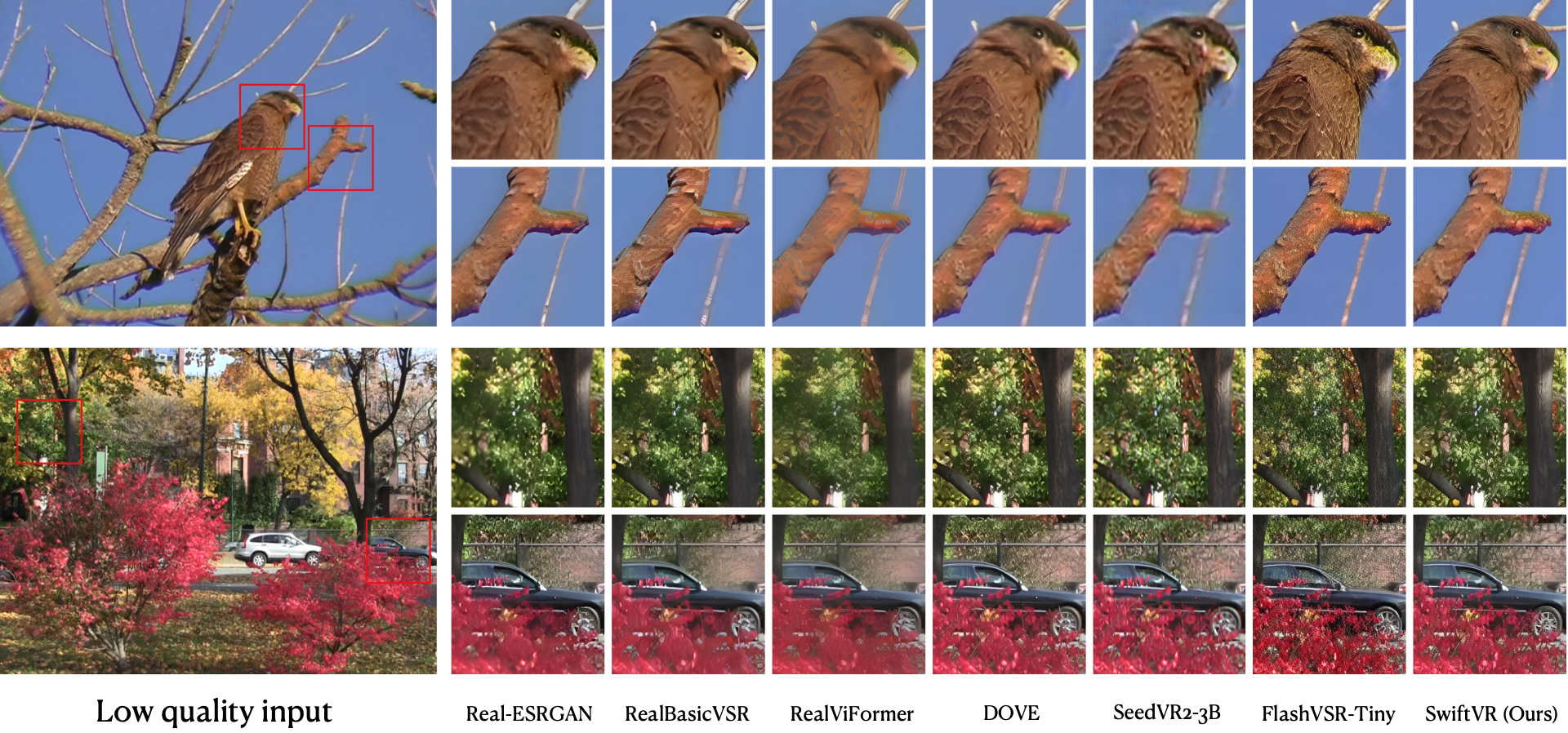
Qualitative comparison
🛠 Installation
git clone https://github.com/Holiday/RVR.git
cd RVR

conda create -n rvr python=3.10 -y
conda activate rvr

# Install PyTorch matching your CUDA toolkit first, e.g. CUDA 12.4:
pip install torch==2.10.0 torchvision==0.25.0 --index-url https://download.pytorch.org/whl/cu124

# Install RVR (editable) and its dependencies:
pip install -e .
Hardware notes
- Server: single H100-80G reproduces the QHD/4K numbers above.
- Consumer: single RTX 5090 reaches ≈26 FPS at 1080p with the same checkpoint (default PyTorch SDPA path, bfloat16, causal chunk protocol).
- No hardware-specific retraining or kernel rewrite is required on any platform.
🗂 Model Zoo
| Model Name | Date | Backbone | Link |
|---|---|---|---|
| RVR | 2026.06 | Wan2.2-TI2V-5B | 🤗 HuggingFace |
huggingface-cli download H-oliday/RVR --local-dir checkpoints/
Expected checkpoint layout (the directory passed to from_pretrained):
checkpoints/
├── reae.safetensors            # Restoration-aware Autoencoder weights
├── prompt_embedding.safetensors# precomputed empty-prompt text embedding (key: "prompt_emb")
└── transformer/                # diffusers-format DiT
    ├── config.json
    └── diffusion_pytorch_model.safetensors
🚀 Quick Start
Python API
from rvr import RVRPipeline

pipe = RVRPipeline.from_pretrained("checkpoints/").to("cuda", dtype="bfloat16")

pipe.restore_video("low_quality.mp4", "restored.mp4", upscale=4)
restore_video also accepts an image folder as input and can write a PNG sequence
(png_save=True). Tunable knobs: clip_len (MIDDLE chunk size, multiple of 4),
dit_overlap, fps, quality (0–100, mapped to x265 CRF), queue_size.
Streaming (causal, chunk by chunk, no future frames)
session = pipe.stream(clip_len=24, resolution=(1920, 1080))

for lq_chunk in read_chunks("low_quality.mp4", n=24):   # lq_chunk: [T, H, W, 3] uint8
    hq = session.step(lq_chunk)        # [1, T', 3, H', W'] in [0, 1], or None if buffered
    if hq is not None:
        write(hq)

tail = session.flush()                 # flush the final buffered frames
Command line
python scripts/inference.py \
  --input low_quality.mp4 \
  --output restored.mp4 \
  --checkpoint checkpoints/ \
  --upscale 4 \
  --clip-len 24 \
  --dtype bfloat16 \
Use --png to write a PNG sequence.
📁 Repository Structure
RVR/
├── README.md
├── requirements.txt
├── setup.py
├── scripts/
│   └── inference.py              # CLI entry point (thin wrapper over RVRPipeline)
└── rvr/
    ├── __init__.py               # exports RVRPipeline
    ├── pipeline.py               # RVRPipeline: from_pretrained / to / restore_video / stream
    ├── runner.py                 # four-stage pipelined runner (reader → H2D → GPU → writer)
    ├── io.py                     # frame reading, GPU preprocessing, mp4 / PNG writing
    ├── models/
    │   ├── reae.py               # ★ Restoration-aware Autoencoder
    │   └── transformer.py        # ★ DiT + mask-free shifted-window self-attention
    └── streaming/
        ├── chunk.py              # fixed-size causal chunk protocol
        ├── tae.py                # streaming autoencoder (causal boundary state)
        └── dit.py                # one-step streaming DiT (fixed timestep, RoPE offsets)
🎬 More Visual Results
Full-length restored clips (low-quality input → RVR, played back to back).
🙏 Acknowledgements
RVR builds on Wan2.2-TI2V-5B, the lightweight autoencoder TAEHV, and the RealBasicVSR degradation pipeline. We thank the authors of SeedVR2, DOVE, and FlashVSR for releasing strong baselines, and the UltraVideo team for the training corpus.
📜 License
Released under the Apache 2.0 License. The Wan2.2 backbone and any third-party weights remain subject to their original licenses.