

Playing to Par: Reinforcement Learning for Provably Optimal Quadrilateral Block Decompositions
Paper • 2609.32146 • Published • 3
The released agent from Playing to Par: Reinforcement Learning for Provably Optimal Quadrilateral Block Decompositions (Arjun Narayanan and Per-Olof Persson, UC Berkeley).
Paper · Code · Project page · Play Mesh Quest
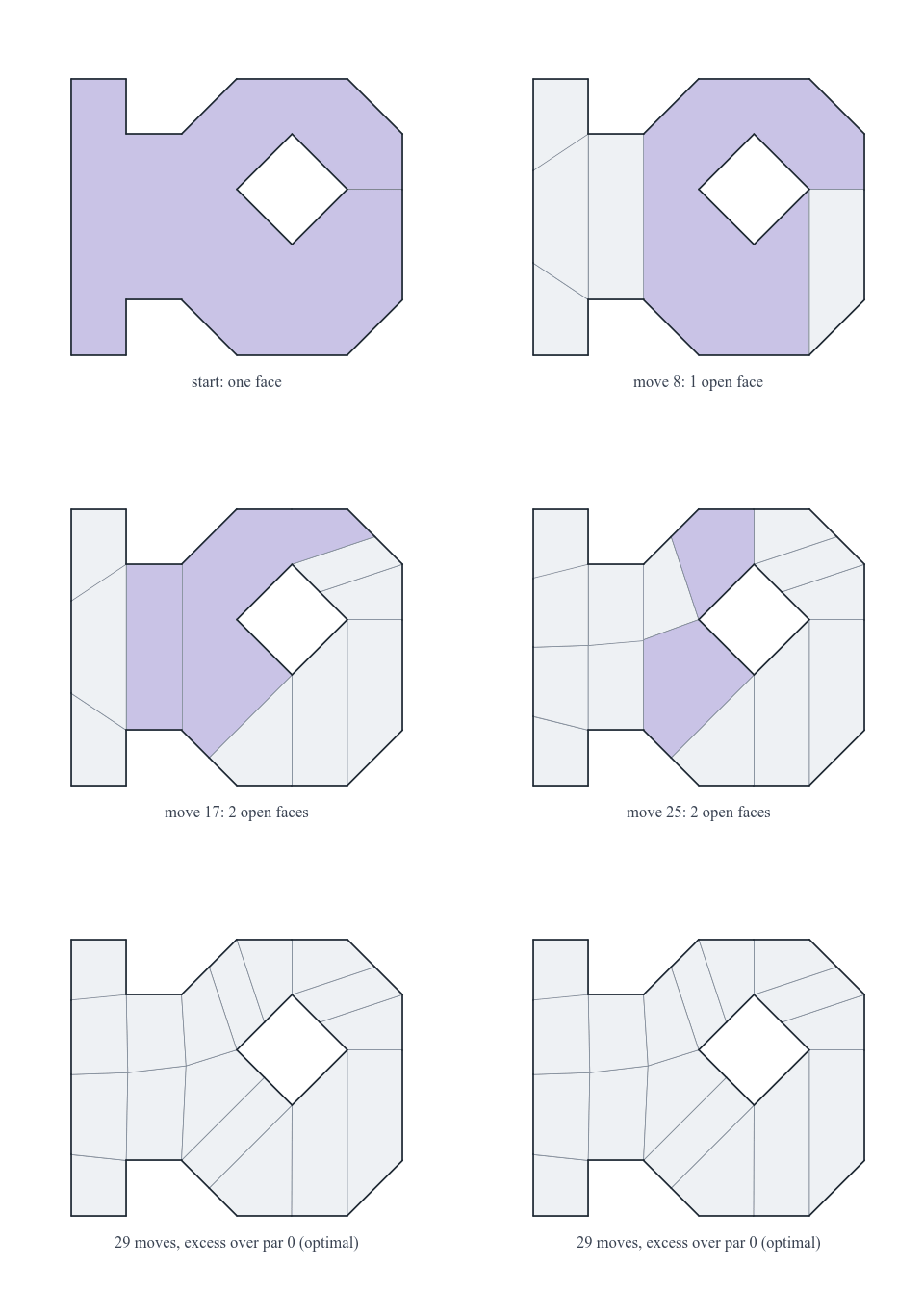
The agent builds a quadrilateral block decomposition from a 2D domain's bare boundary. It aims
for par: the lower bound on vertex irregularity that the discrete Gauss–Bonnet identity
fixes from the domain's corner angles and topology alone, I(M) ≥ par(Ω) = |c(Ω) + 4χ|.
A mesh that reaches par is provably optimal in its connectivity.
next, previous and twin. It has 4 layers of
96 features on 10 input features per half-edge. Because it operates per half-edge with
pooling, it runs unchanged on domains larger than any it saw in training.| File | |
|---|---|
pinwheel-mitq-e2e-v1-4M.zip |
the Stable-Baselines3 PPO checkpoint (includes the optimizer state, so training can resume) |
pinwheel-mitq-e2e-v1.config.yml |
the environment and training config it needs to load |
The checkpoint's policy and feature extractor are classes in the par-quad repository, so load it from a clone of that repository (Python 3.11 or 3.12):
git clone https://github.com/ArjunNarayanan/par-quad.git
cd par-quad
python3.12 -m venv venv
venv/bin/pip install torch==2.7.1 --index-url https://download.pytorch.org/whl/cpu   # CPU-only machines
venv/bin/pip install -r requirements.txt huggingface_hub
export GEOGEN_PATH=tools/geo2d_lite
In Python:
from huggingface_hub import hf_hub_download
from src.geo2d_bridge import load_model

repo = "arjunnarayanan/par-quad-pinwheel-mitq-e2e-v1-4M"
checkpoint = hf_hub_download(repo, "pinwheel-mitq-e2e-v1-4M.zip")
config = hf_hub_download(repo, "pinwheel-mitq-e2e-v1.config.yml")
model = load_model(checkpoint, config)  # a stable_baselines3 PPO model
Or download the files and mesh one domain, writing out/demo.mp4 and out/demo.gif:
venv/bin/hf download arjunnarayanan/par-quad-pinwheel-mitq-e2e-v1-4M --local-dir models/hf
venv/bin/python utilities/animate_rollout.py -suite straight-holes -draw 10 -n 24 \
    -config models/hf/pinwheel-mitq-e2e-v1.config.yml \
    -checkpoint models/hf/pinwheel-mitq-e2e-v1-4M.zip -out out -name demo
The repository README covers the paper's full evaluation procedure, the Gmsh comparison, the curved-boundary repair search and training from scratch.
Held-out mechanical parts under the paper's evaluation procedure (five attempts per domain at a doubled move budget with a split-and-continue repair, averaged over evaluation seeds). Excess is the median number of irregular vertices above par. At par counts domains meshed provably optimally.
96 domains, 8–24 corners
| Method | all-quad | usable | excess | at par |
|---|---|---|---|---|
| Gmsh blossom | 51 | 38 | 9 | 0 |
| Gmsh frontal-quad | 43 | 29 | 8 | 1 |
| Gmsh quasi-structured | 96 | 96 | 7.5 | 2 |
| Gmsh blossom-full | 96 | 96 | 26 | 0 |
| This model | 96.0 | 95.7 | 0 | 90.2 |
64 domains, 25–50 corners (twice the training size, no retraining)
| Method | all-quad | usable | excess | at par |
|---|---|---|---|---|
| Gmsh blossom | 26 | 18 | 39 | 0 |
| Gmsh frontal-quad | 15 | 14 | 34 | 0 |
| Gmsh quasi-structured | 64 | 60 | 22 | 0 |
| Gmsh blossom-full | 64 | 64 | 156 | 0 |
| This model | 64.0 | 62.0 | 0.75 | 31.0 |
Gmsh blossom and frontal-quad run at the agent's element count. Quasi-structured and blossom-full run at their natural sizes, 3–15× the agent's. Curved-boundary results (at par on 37 of 96 curved domains, none seen in training) and the full tables are in the paper.
tools/geo2d_lite) that runs
everything, but it draws different domains from the paper's, so it does not reproduce the
tables above.@article{narayanan2026playing,
title = {Playing to Par: Reinforcement Learning for Provably Optimal
Quadrilateral Block Decompositions},
author = {Narayanan, Arjun and Persson, Per-Olof},
journal = {arXiv preprint arXiv:2609.32146},
year = {2026}
}