

HamsTTS — Levantine Arabic / English Code-Switching TTS
Fine-tuned from facebook/mms-tts-ara
(VITS architecture, 46.7M params) for low-latency streaming text-to-speech
spanning Levantine Arabic, English, and code-switching between them.
Built for Hams.AI. Code, the full design doc,
evaluation results, and sample audio all live in the GitHub repo (this
HF repo holds only the checkpoint + this card):
github.com/abkw/hams-tts — see
the design doc
there for full methodology, benchmark results, and known limitations.
License note: facebook/mms-tts-ara (the base checkpoint) is licensed
CC BY-NC 4.0 (non-commercial) by Meta. This fine-tuned checkpoint inherits
that license.
Model description
- Architecture: VITS (Conditional VAE + adversarial training, non-autoregressive, flow-based duration modeling).
- Vocabulary: custom 64-symbol phoneme inventory (not the base checkpoint's character-level Arabic vocabulary) — IPA-derived phonemes from espeak-ng, Levantine-corrected (ق→ʔ, ج→ʒ, dialect lexicon overrides), shared across Arabic and English, plus two Private-Use-Area marker codepoints for language conditioning.
- Speakers: 3 (one per training corpus — ClArTTS, Arabic Speech
Corpus, LJSpeech), selectable via
speaker_id.
Intended use
Low-latency streaming TTS for Levantine-Arabic/English conversational agents (voice assistants, IVR, accessibility tools) where natural code-switching between the two languages is expected. Not intended for: other Arabic dialects (Gulf, Maghrebi, Egyptian — pronunciation rules are Levantine-specific), non-conversational/formal MSA narration (base MSA pronunciation is intentionally overridden toward dialect), or any use prohibited by the base checkpoint's CC BY-NC 4.0 non-commercial license.
Training data
13,033 utterances: ClArTTS (9,460, MSA, diacritized — the full corpus), Arabic Speech Corpus (1,873, Syrian-accented MSA — the full corpus), LJSpeech (1,700, American English). No code-switched audio exists in the training set — see the design doc's limitations section (linked above) for why, and what that implies for code-switch quality.
This is the third fine-tuning round. Round 1 trained on a smaller 1,500-row slice of ClArTTS (~5,073 rows total, 50 epochs); round 2 moved to the full ClArTTS corpus used here but at fewer epochs (20) to hold training time roughly constant; round 3 (this checkpoint) keeps round 2's full dataset but trains for more epochs (30) after real listening feedback found round 2 under-converged on English specifically while Arabic gains from the larger dataset held up. Full three-round comparison: design doc §4.
How to use
This checkpoint uses a custom tokenizer vocabulary, not the standard MMS
character tokenizer — text must be pre-phonemized with this project's
own pipeline before tokenization (plain pipeline("text-to-speech", ...)
on raw Arabic/English text will not work correctly). Clone
the repo for the phonemization
pipeline (hams_tts.text) this depends on:
import sys
sys.path.insert(0, "src")  # inside a clone of github.com/abkw/hams-tts

from hams_tts.inference.engine import Engine

engine = Engine(model_dir="<this checkpoint>", tokenizer_dir="<this checkpoint>")
audio, sampling_rate = engine.synthesize("بدي أروح ع meeting بكرا")
Evaluation
Measured on an RTX 4070 Ti (12 GB) — the final cited hardware for this project; no L4 access was available, and every margin below is wide enough that the hardware choice isn't expected to flip a pass/fail. Full methodology: design doc §4 / eval_results.md.
Latency/resource KPIs (server-mode, end-to-end, 18 held-out utterances):
| Metric | Target | Measured (round 3) |
|---|---|---|
| TTFA p50 | < 300 ms | 51.3 ms |
| TTFA p95 | < 300 ms | 139.2 ms |
| RTF (mean) | < 0.3 | 0.023 |
| Peak VRAM | ≤ 3 GB | 1.05 GB |
All four pass with wide margin, consistently across all three training rounds (inference architecture/precision never changed, only training data/epochs did).
ASR round-trip (faster-whisper large-v3) + DNSMOS (reference-free audio quality, 1-5, higher=better — not the same direction as CER/WER, where lower=better), across all three training rounds:
| Category | R1 error rate | R1 DNSMOS | R2 error rate | R2 DNSMOS | R3 error rate (deployed) | R3 DNSMOS (deployed) |
|---|---|---|---|---|---|---|
| Pure Arabic | 0.363 CER | 3.06 | 0.346 CER | 3.19 | 0.384 CER | 3.20 |
| Pure English | 0.048 WER | 3.03 | 0.079 WER | 2.96 | 0.021 WER | 3.10 |
| Code-switched | 0.593 CER | 3.13 | 0.589 CER | 3.30 | 0.587 CER | 3.27 |
Data used per round:
| Round | ClArTTS rows | ASC rows | LJSpeech rows | Total rows | Epochs |
|---|---|---|---|---|---|
| 1 | 1,500 | 1,873 | 1,700 | 5,073 | 50 |
| 2 | 9,460 (full) | 1,873 | 1,700 | 13,033 | 20 |
| 3 (deployed) | 9,460 (full) | 1,873 | 1,700 | 13,033 | 30 |
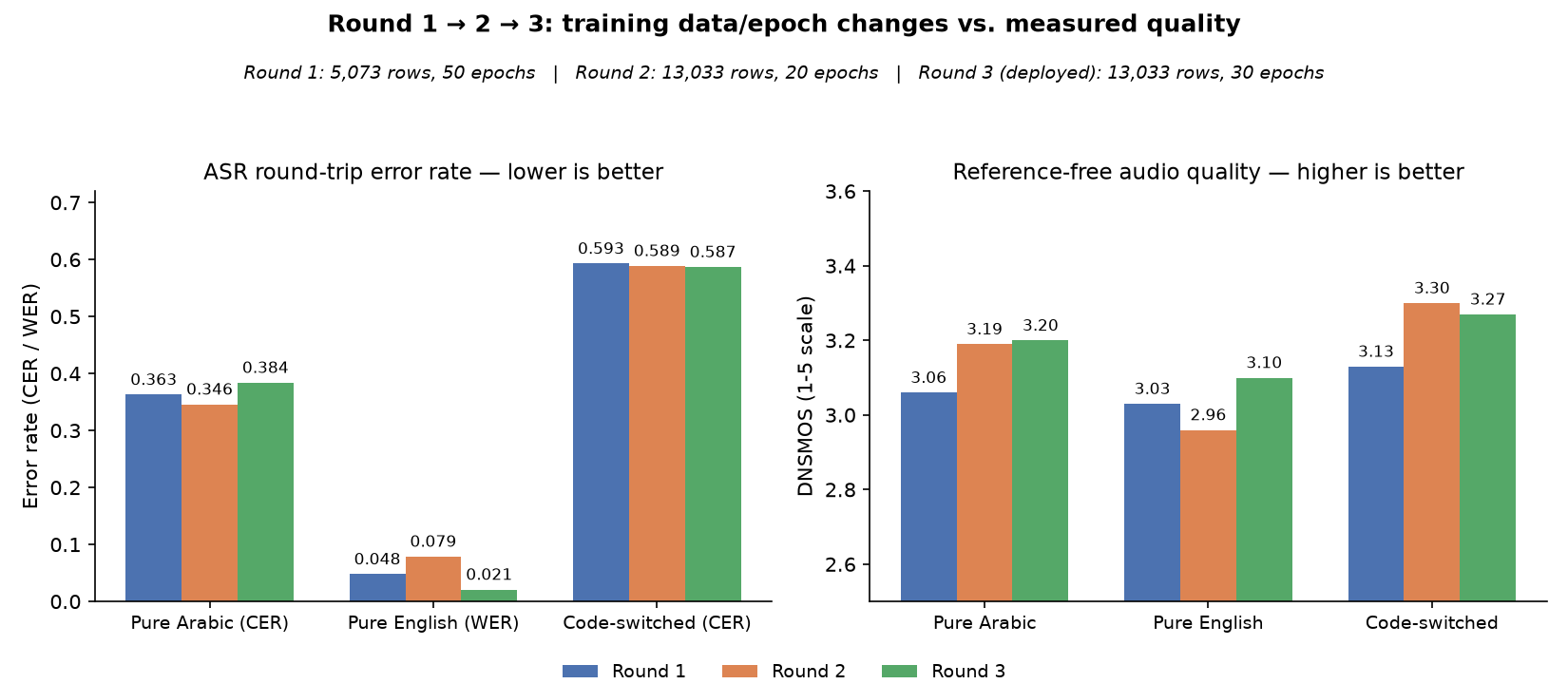
Arabic/code-switched CER is not low in absolute terms, and that's partly real and partly a quirk of the metric: Whisper transcribes to standard orthography, while this model deliberately speaks Levantine pronunciation (ق→ʔ, dialect lexicon, etc.) that diverges from it by design, so part of the "error" is the metric's reference being the wrong ground truth, not the model mispronouncing.
Confirmed by human listening, not just by these metrics — and this
is where the concrete fixes in this project's history actually came
from, not just a caveat. Listening on round 2 surfaced two different
problems: (1) mishkal mis-diacritizing specific dialect words as
unrelated MSA words entirely (e.g. dialect عم → MSA عَمٌّ "uncle") — a
pure text-pipeline bug, fixed via 8 new lexicon entries in
levantine_rules.py, no retraining required; (2) a genuine model-level
confusion between ح/ʕ for at least one word ("مرحبا" heard as "مرعبا"
despite the phoneme pipeline correctly outputting /ħ/) — not fixable by
a lexicon entry, recorded as a known open limitation. Round 3 (more
epochs on the same full-corpus dataset) recovered English quality to its
best level across all three rounds while holding Arabic's round-2 gains;
Arabic DNSMOS itself barely moved round 2→3, suggesting the next lever
for further Arabic improvement is a different/additional corpus, not
more epochs on ClArTTS+ASC, both of which round 3 has now trained on
fairly thoroughly.
Round 3 was confirmed as an improvement by direct listening, not just by DNSMOS — the project owner listened to round 3 against the same samples and confirmed it sounds better than round 2. This checkpoint is the final deployed result for this project, not a placeholder awaiting further listening. Given the training scale here (13,033 utterances across 2 Arabic speakers, no hyperparameter sweep) against production Arabic TTS systems typically trained on hundreds of hours across many speakers, intelligible-but-imperfect is a believable, expected result at this scale, not a sign of a bug.
Limitations
See design doc §5 for the full list. Headline items: no code-switched training audio; language conditioning is token-level rather than a dedicated per-frame embedding; Levantine lexicon overrides are exact-surface-form matches (don't generalize across Arabic's clitic/prefix morphology).
- Downloads last month
- 69
Model tree for mohammed/hams-tts-levantine
Base model
facebook/mms-tts-ara